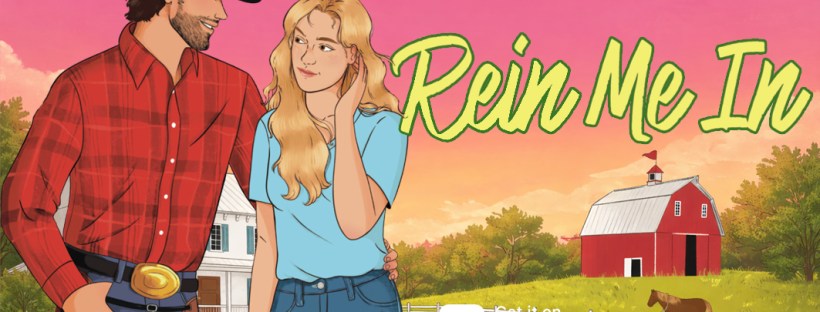
AN ENEMIES TO LOVERS, SINGLE DAD, SMALL TOWN, COWBOY ROMANCE

Can he lasso her heart?
Faye came to Blue Crescent Harbor for a fresh start. A place to disappear, teach first grade, and keep her secrets buried. She didn’t expect the hottest single dad in school and small-town royalty to march into her classroom to share his stubborn opinions. Tall, rugged, and fiercely devoted to his son, he’s a walking complication in flannel and cowboy boots.
Ryder has no patience for anyone telling him how to raise his kid. Especially not a sharp-tongued teacher with city polish and eyes promising trouble. Their mutual dislike is second only to their explosive chemistry!
Too bad she can’t avoid him. At parent meetings. On the dancefloor at the local dive bar. In her dreams, wearing that backward baseball cap and a grin that makes her forget she’s sworn off men. But he’s off-limits. She’s his son’s teacher, and this town loves to gossip. Yet Ryder’s flirty banter, his son’s adoration, and his dedication to his family’s ranch make sticking to the rules difficult. Staying invisible was the plan, but he makes her want to be seen. What if the real risk is not running, but wanting to stay?
EBOOK:







Chapter One
Faye
A man-shaped eclipse obscures the doorway of my classroom. After a day teaching twenty-two first graders, that shadow is the last thing I have energy for; all I want is to close my eyes and enjoy the silence settling over the empty class. Instead, I pull my professional mask back on and compose myself, gearing up for a delicate conversation.
My gaze drifts to the man I asked to meet, surprised he actually showed up after several near misses in the past eight months. He fills the doorframe so completely, he appears like a giant compared to the Lilliputian rows of empty desks with tiny chairs tucked underneath.
He ducks as he comes in, even if the frame clears his height by a few inches. The gesture seems automatic, born from too many encounters with low beams. He removes a blue-and-silver Bobcats cap—the local high school football team everyone is obsessed with in this town—that he presses against his chest like he’s entering a church. The other hand rakes through his hair, chestnut brown and longish, hitting somewhere between his jaw and collar. The attempted combing only makes it worse, or better, depending on how one looks at it. His locks now fall in untamed waves that beg for more fingers to sort through them.
Dust clings to his boots and jeans as if he’s walked straight from the fields into my classroom, which, given the state of his clothes, he probably has. April in Missouri, I’ve learned, means planting season, and this man wears the evidence of a life spent outdoors from the knees down.
But the tight white Henley stretched across his chest is pristine, the fabric straining against lean, flat muscles that must come from physical labor rather than a gym membership.
The sleeves are rolled up to his elbows, revealing forearms that are alarmingly fascinating. Corded and tan and dusted with the same soft, blondish hair that peeks from where the first two buttons of his shirt are undone. He has a checkered flannel tied around his waist.
When I look at his face, his eyes stop me cold. Framed by dark lashes and set beneath strong brows, they are a blue so deep it borders on violet. It’s the same shade I see every morning when Rhys Evans bounds into my classroom with grass stains on his knees and mischief in his grin.
His father is absurdly hot. Ryder Evans is sex in flannels. A mistake you’d make twice. He’s… just whoa. Better vocabulary escapes me as I stare at him silhouetted in the late-afternoon glow. Dust motes drift through the beams of light, restless as the unsettled thoughts I shouldn’t be having before a parent–teacher conference.
“Miss Rose’s class?” His voice fills the empty room, deep and gravelly—as dusty as his boots. He sounds parched, as if he needs water after spending many hours under the warming spring sun. That scrape of roughness lands somewhere low in my belly.
I give myself a mental shake. I’ve asked him here to discuss his son’s well-being during a potentially difficult school event, not to admire the curve of his biceps or the fullness of his bottom lip or wonder what that scruff along his angular jaw would feel like against my palm.
In my defense, it’s been a long day. Teaching first grade can be more taxing than any grind I put in at other jobs. Hard work that leaves my brain fried by mid-afternoon and my patience tested in ways I didn’t know existed. But it is also so rewarding. I love it. And I love the kids. The satisfaction of shaping their young minds, of seeing curiosity bloom in their eyes and wonder flicker over their faces with every discovery, hearing their laughter and wild questions.
Right, my students.
We’re meeting to discuss one of them. I need to focus on that and not the way his father’s shoulders fill out clothes.
“Yes.” I stand, flattening my palms on the desk. “You must be Rhys’s father. Nice to finally meet you.”
He crosses the room in four long strides, each one making him seem larger, taller. The classroom that feels spacious even with twenty-two seven-year-olds around suddenly seems cramped with just the two of us in it. He extends his arm, but not far; I have to meet him halfway to shake hands. Hard calluses scrape against my softer skin—not unpleasantly. A tingle runs from the point of contact up my arm, spreading over my shoulder and lodging somewhere behind my collarbone.
“Ryder Evans.”
The introduction is simple. Gruff. No wasted words. His hand engulfs mine, dry and firm. The grip is sure, but he doesn’t overdo it.
“Faye Rose.” I let go of his hand and gesture to the adult-sized chair I’ve positioned in front of my desk, the only spare piece of furniture in this room not designed for a tiny person under five feet tall. “Please have a seat.”
He lowers himself into the chair with the air of a man dragged indoors against his will. Shoulders tense and posture stiff. His gaze flicks around the room, over the alphabet charts on the walls, the bin of building blocks in the corner, the colorful rug where the kids gather for story time. He glances at the wall clock next, attitude screaming, Can we make this quick?, then fixes those eyes back on me.
His knee bounces once, twice, before he stills it. A restlessness that suggests I’ve cost him an hour he doesn’t want to give. Or doesn’t have to spare if his track record is any indication.
Ryder Evans hasn’t been able to make a single school event this year, except for the Christmas recital, when I didn’t have a chance to meet with the parents. Despite that, I never got the impression Rhys is a neglected kid. And this man has checked every progress report on the school portal and replied to all school–family communications—sometimes at weird hours of the night that could be early mornings for him.
Rhys’s grandmother has handled all in-person school meetings so far. And his aunt, Becky, is my landlord and a friend. I know from both of them that the Evanses run a busy farm with limited outside help. School hours don’t bend easily around a life like that. Still, this conversation is too delicate for an email. I made it clear I’d rather discuss it with him directly and in person. But I’ll steal as little of his time as I can.
Cutting the meeting short will also limit the drool threatening to disgrace my desk—and my dignity.
“What’s this about?” He cuts straight through any pleasantries I might have offered. “Is Rhys in trouble?”
“No, not at all.” I settle back into my chair, shuffling addition problems and spelling tests out of the way. “Rhys is an excellent student. Bright, engaged, always eager to take part.”
Ryder Evans doesn’t relax; it’s as if he’s waiting for the other boot to drop.
“He’s poised,” I continue, “a little boisterous sometimes, but nothing I wouldn’t expect from a seven-year-old. He knows when to cut the shenanigans and turn serious. I’m very happy with how he conducts himself in class.”
“Okay,” he grunts in a tone that could be satisfaction. His fingers drum against his thigh. “Then why am I here?”
I get the sense that what he wanted to say is, Why are you wasting my time if my kid’s doing fine?
“Mr. Evans, I wanted to discuss an upcoming event.” I’m sweating under a cardigan that’s doing its best to become a wearable oven. “The school is planning a Mother’s Day celebration for next month.”
The change is immediate. His spine stiffens, and those remarkable eyes darken like storm clouds rolling in over the lake. The drumming fingers still.
I plow forward, even if every instinct tells me I’m walking into a minefield. “The mothers of all students are invited to spend the morning in class with their children. There will be activities, crafts, and a small presentation the students have been preparing.
“When I reviewed Rhys’s file, I noticed no one is listed in the mother field on his enrollment forms.”
His mouth flattens into a line, muscle jaw flexing.
“And having never met either parent—”
“Rhys’s mother isn’t around, but he has a father who’s more than enough.” His voice has dropped another octave, gravel grinding to dust.
“Mr. Evans, I didn’t mean to imply—”
“My son lacks for nothing.” He doesn’t let me finish; he doubles down, leaning forward in the chair. “I raised that boy from day one with no gaps or shortcomings. I don’t care what a piece of paperwork says.”
“Of course, I wasn’t—”
“Rhys has plenty of support,” he barrels on. His voice doesn’t rise, but it hardens. “He’s got me, his grandmother, his aunt, his uncle. He’s surrounded by people who love him and show up for him every day.”
A pang of sympathy sweeps across my chest. I’ve clearly hit a nerve, opened a wound that hasn’t healed. I want to apologize, to explain that my intention is to help, not hurt, but Ryder Evans isn’t done.
“The Evans name carries weight in Blue Crescent Harbor.” His tone takes on an entitled edge that grates away my sympathy instantly. “We’ve been here for generations. Our ancestors have built this town, supported it, kept it going when others left. My son is growing up in a good home, with good people, on good land. And I don’t need some out-of-towner teacher questioning what makes a proper family.”
That does it. My tolerance evaporates. I understand being defensive about parenting; I really do. But the condescension in his tone, the dismissiveness, the way he’s bulldozing over me and not letting me speak? No, I’m done. No more drool hazard. Nothing turns me off faster than misplaced male arrogance.
“He’s doing fine even without his mother, and he doesn’t need some manufactured holiday celebration to remind him of what he doesn’t have. He knows he’s loved and valued. We don’t need anybody’s pity.”
He’s on a roll now. I see where Rhys gets his stubborn streak, but the son wears it with far more charm than the father. I consider interrupting, but the set of Ryder’s shoulders and the clipped cadence of his words tell me he won’t pause long enough to let me correct him. Instead, I endure the monologue with a calm that I know will irritate him more than any argument.
“You think because you’ve got a teaching certificate and ideas from whatever city you came from that you know better?”
I lean back against my chair and cross my arms, letting him wear himself out. He’s like one of those summer storms that blow through the Ozarks—thunder and lightning and fury, but ultimately just water. His dismissive, pompous declarations wash over me. Ryder Evans is a bullheaded brute. Full of himself. Insufferable. How does sweet, clever Rhys come from this man? The kid must spend most of his time with Becky and his grandmother.
“The last thing my son needs is to be singled out, made to feel different because his family doesn’t fit into your neat little checkbox on a form. Whatever accommodation or special treatment you’re planning to offer, you can keep it.”
By the time he runs out of steam, the room has fallen into a hush so absolute I can hear the tick of the clock on the wall.
I wait another beat, making sure he’s truly finished, that the storm has passed. Then I uncross my arms with measured calm.
“Are you done?” I keep my tone civil, even while I’m seething. “Because if you are finished, Mr. Evans, I’d like the chance to explain why I called you in.”
KEEP READING CHAPTER TWO…
OR GRAB YOUR COPY IN eBook:

OR AudioBook:








One thought on “Rein Me In”