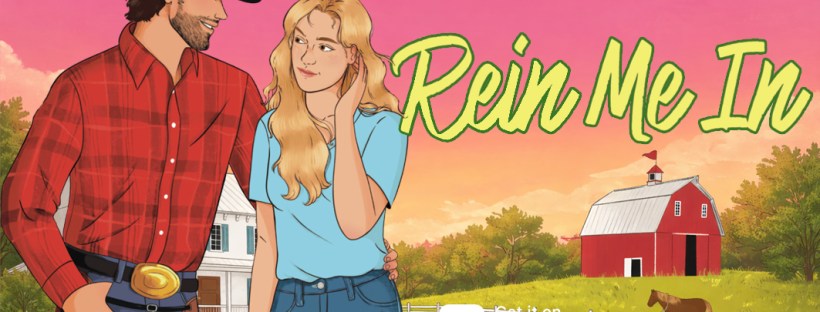
Rein Me In

AN ENEMIES TO LOVERS, SINGLE DAD, SMALL TOWN, COWBOY ROMANCE

firefighter Romantic Comedy

Can he lasso her heart?

Faye came to Blue Crescent Harbor for a fresh start. A place to disappear, teach first grade, and keep her secrets buried. She didn’t expect the hottest single dad in school and small-town royalty to march into her classroom to share his stubborn opinions. Tall, rugged, and fiercely devoted to his son, he’s a walking complication in flannel and cowboy boots.

Ryder has no patience for anyone telling him how to raise his kid. Especially not a sharp-tongued teacher with city polish and eyes promising trouble. Their mutual dislike is second only to their explosive chemistry!

Too bad she can’t avoid him. At parent meetings. On the dancefloor at the local dive bar. In her dreams, wearing that backward baseball cap and a grin that makes her forget she’s sworn off men. But he’s off-limits. She’s his son’s teacher, and this town loves to gossip. Yet Ryder’s flirty banter, his son’s adoration, and his dedication to his family’s ranch make sticking to the rules difficult. Staying invisible was the plan, but he makes her want to be seen. What if the real risk is not running, but wanting to stay?

EBOOK:


Chapter One

Faye

A man-shaped eclipse obscures the doorway of my classroom. After a day teaching twenty-two first graders, that shadow is the last thing I have energy for; all I want is to close my eyes and enjoy the silence settling over the empty class. Instead, I pull my professional mask back on and compose myself, gearing up for a delicate conversation.

My gaze drifts to the man I asked to meet, surprised he actually showed up after several near misses in the past eight months. He fills the doorframe so completely, he appears like a giant compared to the Lilliputian rows of empty desks with tiny chairs tucked underneath.

He ducks as he comes in, even if the frame clears his height by a few inches. The gesture seems automatic, born from too many encounters with low beams. He removes a blue-and-silver Bobcats cap—the local high school football team everyone is obsessed with in this town—that he presses against his chest like he’s entering a church. The other hand rakes through his hair, chestnut brown and longish, hitting somewhere between his jaw and collar. The attempted combing only makes it worse, or better, depending on how one looks at it. His locks now fall in untamed waves that beg for more fingers to sort through them.

Dust clings to his boots and jeans as if he’s walked straight from the fields into my classroom, which, given the state of his clothes, he probably has. April in Missouri, I’ve learned, means planting season, and this man wears the evidence of a life spent outdoors from the knees down.

But the tight white Henley stretched across his chest is pristine, the fabric straining against lean, flat muscles that must come from physical labor rather than a gym membership.

The sleeves are rolled up to his elbows, revealing forearms that are alarmingly fascinating. Corded and tan and dusted with the same soft, blondish hair that peeks from where the first two buttons of his shirt are undone. He has a checkered flannel tied around his waist.

When I look at his face, his eyes stop me cold. Framed by dark lashes and set beneath strong brows, they are a blue so deep it borders on violet. It’s the same shade I see every morning when Rhys Evans bounds into my classroom with grass stains on his knees and mischief in his grin.

His father is absurdly hot. Ryder Evans is sex in flannels. A mistake you’d make twice. He’s… just whoa. Better vocabulary escapes me as I stare at him silhouetted in the late-afternoon glow. Dust motes drift through the beams of light, restless as the unsettled thoughts I shouldn’t be having before a parent–teacher conference.

“Miss Rose’s class?” His voice fills the empty room, deep and gravelly—as dusty as his boots. He sounds parched, as if he needs water after spending many hours under the warming spring sun. That scrape of roughness lands somewhere low in my belly.

I give myself a mental shake. I’ve asked him here to discuss his son’s well-being during a potentially difficult school event, not to admire the curve of his biceps or the fullness of his bottom lip or wonder what that scruff along his angular jaw would feel like against my palm.

In my defense, it’s been a long day. Teaching first grade can be more taxing than any grind I put in at other jobs. Hard work that leaves my brain fried by mid-afternoon and my patience tested in ways I didn’t know existed. But it is also so rewarding. I love it. And I love the kids. The satisfaction of shaping their young minds, of seeing curiosity bloom in their eyes and wonder flicker over their faces with every discovery, hearing their laughter and wild questions.

Right, my students.

We’re meeting to discuss one of them. I need to focus on that and not the way his father’s shoulders fill out clothes.

“Yes.” I stand, flattening my palms on the desk. “You must be Rhys’s father. Nice to finally meet you.”

He crosses the room in four long strides, each one making him seem larger, taller. The classroom that feels spacious even with twenty-two seven-year-olds around suddenly seems cramped with just the two of us in it. He extends his arm, but not far; I have to meet him halfway to shake hands. Hard calluses scrape against my softer skin—not unpleasantly. A tingle runs from the point of contact up my arm, spreading over my shoulder and lodging somewhere behind my collarbone.

“Ryder Evans.”

The introduction is simple. Gruff. No wasted words. His hand engulfs mine, dry and firm. The grip is sure, but he doesn’t overdo it.

“Faye Rose.” I let go of his hand and gesture to the adult-sized chair I’ve positioned in front of my desk, the only spare piece of furniture in this room not designed for a tiny person under five feet tall. “Please have a seat.”

He lowers himself into the chair with the air of a man dragged indoors against his will. Shoulders tense and posture stiff. His gaze flicks around the room, over the alphabet charts on the walls, the bin of building blocks in the corner, the colorful rug where the kids gather for story time. He glances at the wall clock next, attitude screaming, Can we make this quick?, then fixes those eyes back on me.

His knee bounces once, twice, before he stills it. A restlessness that suggests I’ve cost him an hour he doesn’t want to give. Or doesn’t have to spare if his track record is any indication.

Ryder Evans hasn’t been able to make a single school event this year, except for the Christmas recital, when I didn’t have a chance to meet with the parents. Despite that, I never got the impression Rhys is a neglected kid. And this man has checked every progress report on the school portal and replied to all school–family communications—sometimes at weird hours of the night that could be early mornings for him.

Rhys’s grandmother has handled all in-person school meetings so far. And his aunt, Becky, is my landlord and a friend. I know from both of them that the Evanses run a busy farm with limited outside help. School hours don’t bend easily around a life like that. Still, this conversation is too delicate for an email. I made it clear I’d rather discuss it with him directly and in person. But I’ll steal as little of his time as I can.

Cutting the meeting short will also limit the drool threatening to disgrace my desk—and my dignity.

“What’s this about?” He cuts straight through any pleasantries I might have offered. “Is Rhys in trouble?”

“No, not at all.” I settle back into my chair, shuffling addition problems and spelling tests out of the way. “Rhys is an excellent student. Bright, engaged, always eager to take part.”

Ryder Evans doesn’t relax; it’s as if he’s waiting for the other boot to drop.

“He’s poised,” I continue, “a little boisterous sometimes, but nothing I wouldn’t expect from a seven-year-old. He knows when to cut the shenanigans and turn serious. I’m very happy with how he conducts himself in class.”

“Okay,” he grunts in a tone that could be satisfaction. His fingers drum against his thigh. “Then why am I here?”

I get the sense that what he wanted to say is, Why are you wasting my time if my kid’s doing fine?

“Mr. Evans, I wanted to discuss an upcoming event.” I’m sweating under a cardigan that’s doing its best to become a wearable oven. “The school is planning a Mother’s Day celebration for next month.”

The change is immediate. His spine stiffens, and those remarkable eyes darken like storm clouds rolling in over the lake. The drumming fingers still.

I plow forward, even if every instinct tells me I’m walking into a minefield. “The mothers of all students are invited to spend the morning in class with their children. There will be activities, crafts, and a small presentation the students have been preparing.

“When I reviewed Rhys’s file, I noticed no one is listed in the mother field on his enrollment forms.”

His mouth flattens into a line, muscle jaw flexing.

“And having never met either parent—”

“Rhys’s mother isn’t around, but he has a father who’s more than enough.” His voice has dropped another octave, gravel grinding to dust.

“Mr. Evans, I didn’t mean to imply—”

“My son lacks for nothing.” He doesn’t let me finish; he doubles down, leaning forward in the chair. “I raised that boy from day one with no gaps or shortcomings. I don’t care what a piece of paperwork says.”

“Of course, I wasn’t—”

“Rhys has plenty of support,” he barrels on. His voice doesn’t rise, but it hardens. “He’s got me, his grandmother, his aunt, his uncle. He’s surrounded by people who love him and show up for him every day.”

A pang of sympathy sweeps across my chest. I’ve clearly hit a nerve, opened a wound that hasn’t healed. I want to apologize, to explain that my intention is to help, not hurt, but Ryder Evans isn’t done.

“The Evans name carries weight in Blue Crescent Harbor.” His tone takes on an entitled edge that grates away my sympathy instantly. “We’ve been here for generations. Our ancestors have built this town, supported it, kept it going when others left. My son is growing up in a good home, with good people, on good land. And I don’t need some out-of-towner teacher questioning what makes a proper family.”

That does it. My tolerance evaporates. I understand being defensive about parenting; I really do. But the condescension in his tone, the dismissiveness, the way he’s bulldozing over me and not letting me speak? No, I’m done. No more drool hazard. Nothing turns me off faster than misplaced male arrogance.

“He’s doing fine even without his mother, and he doesn’t need some manufactured holiday celebration to remind him of what he doesn’t have. He knows he’s loved and valued. We don’t need anybody’s pity.”

He’s on a roll now. I see where Rhys gets his stubborn streak, but the son wears it with far more charm than the father. I consider interrupting, but the set of Ryder’s shoulders and the clipped cadence of his words tell me he won’t pause long enough to let me correct him. Instead, I endure the monologue with a calm that I know will irritate him more than any argument.

“You think because you’ve got a teaching certificate and ideas from whatever city you came from that you know better?”

I lean back against my chair and cross my arms, letting him wear himself out. He’s like one of those summer storms that blow through the Ozarks—thunder and lightning and fury, but ultimately just water. His dismissive, pompous declarations wash over me. Ryder Evans is a bullheaded brute. Full of himself. Insufferable. How does sweet, clever Rhys come from this man? The kid must spend most of his time with Becky and his grandmother.

“The last thing my son needs is to be singled out, made to feel different because his family doesn’t fit into your neat little checkbox on a form. Whatever accommodation or special treatment you’re planning to offer, you can keep it.”

By the time he runs out of steam, the room has fallen into a hush so absolute I can hear the tick of the clock on the wall.

I wait another beat, making sure he’s truly finished, that the storm has passed. Then I uncross my arms with measured calm.

“Are you done?” I keep my tone civil, even while I’m seething. “Because if you are finished, Mr. Evans, I’d like the chance to explain why I called you in.”

KEEP READING CHAPTER TWO… 

OR GRAB YOUR COPY IN eBook:


OR AudioBook:

THE HEAT OF THE MOMENT

THE HEAT OF THE MOMENT

 width=A neighbors to lovers, friends to lovers, single mom, firefighter romance 

Four years after losing her husband in the line of duty, ER nurse Lily Finnigan has one goal: raise her daughter and keep her heart safely locked away. Romance—even a simple fling—isn’t on the agenda. Until Josh Collins walks into her emergency room.

Gorgeous, charming, and infuriatingly kind, he is everything Lily doesn’t want—but can’t seem to stay away from.

What I love most about this book: Josh is just so swoony… usually my books are happy, happy but this one made me cry a lot while writing it. And I love it for it❤️‍🔥


All tropes: NEIGHBORS TO LOVERS, FIREFIGHTER ROMANCE, SINGLE MOM

Part of a series? Yes, but can be read as a standalone.

I’ve written a lot of love stories. But this one broke me open in ways I didn’t expect.

I cried while writing The Heat of the Moment. Sometimes I had to step away from my laptop because I couldn’t see the screen anymore. And then, somehow, I’d find myself laughing out loud at Josh being a total golden retriever stuck in the friend zone, at the banter, at the moments of lightness that Lily desperately needed.

Do you remember the mustache scene from You Rock My World? The one where Josie shows up to a meeting with a curly mustache drawn on her face in permanent marker because she stepped in to play Penny’s “dad” for Bring Your Dad to School Day. Her niece needed someone to fill an impossible void, and Josie showed up, ridiculous fake facial hair and all.

When I wrote that scene, something cracked open in my chest. Behind that absurd, laugh-out-loud moment was heartbreak—a little girl missing her father, and a woman carrying not just her grief, but her child’s too.

That woman was Lily.

Lily haunted me after I finished writing Josie’s book. I couldn’t stop thinking about what it takes to wake up every day after losing the person you built your life with. To raise a daughter alone. To be strong enough to hold space for a child’s sadness while your own threatens to swallow you whole. I knew I had to give her a story. A second chance. A happily ever after.

Early reviews have been coming in, and I’m also receiving more private messages about how this story has touched people than I ever have before. And I’ve been crying all over again. Some of you have shared pieces of your own stories with me. One reader reached out to say she’d lost someone close to her a few years back, and the way I wrote those hard moments of single parenthood and grief felt deeply personal to her experience.

Another message came from someone in a fallen firefighter’s family. All she could say was that she wasn’t ready to process her emotions yet, but the book was brilliant.

I’ve never had a book where readers sent me voice notes because they couldn’t type through their tears. Where someone messaged me at 2am saying “I wasn’t supposed to stay up but I couldn’t put it down.” These messages gutted me in the best possible way. This is why I write: not just for the happily ever after, but for the messy, devastating, beautiful journey of getting there.

Here’s what I’ve learned from Lily: sometimes the bravest thing you can do is let yourself want something again.

Josh doesn’t show up with grand declarations or promises to fix everything. He doesn’t rescue Lily. He shows up with dinner when Lily’s had a brutal shift. He makes her daughter laugh. He’s patient when Lily pushes him away, and he doesn’t flinch when she finally lets him in. He just refuses to let her keep pretending she doesn’t deserve good things. He’s the kind of love that doesn’t ask you to forget your past—it asks if there’s room for a future too.

And watching her fight him on it, then slowly—painfully—let herself hope again? That’s the love story I needed to write.

Maybe it’s because Lily’s journey—from survival mode to actually living again—is one so many of us understand, whether we’ve lost a partner or not.

We all know what it’s like to protect ourselves. To say “I’m fine with how things are” when we’re actually just terrified of wanting more and losing it.

But this book is not all tears and banter; there’s action, too. Wildfires. Emergency rooms at full tilt. Pulse-pounding moments that have early reviewers saying things like: “Since I started watching 9-1-1 a month ago my brain has been all on firefighters so this book came at such a good time for me.” and “It felt like I was reading an episode of Chicago Fire in the best way possible!” and “If you love Grey’s Anatomy or Station 19 or Chicago Med—this is for you.”

If you love the tension, the heroism, the romance woven between emergency room chaos and fireground danger—if you’ve been on the fence about reading it, here’s what I’ll say: this book will make you feel everything. The wildfire scenes will have your heart racing. The banter will make you smile. And yes, you’ll probably cry. But you’ll also close the last page believing that broken hearts can heal without erasing what came before. Lily and Josh’s story will feel like coming home.

The Heat of the Moment is available everywhere today.

And if you haven’t read book one yet, you’ve got the perfect excuse to dive into Josie’s story. You Rock My World is free in Kindle Unlimited and Kobo Plus (also in Kobo Plus in Audiobook).

Thank you for being here. For trusting me with your time, your hearts, and your stories. For showing up for Lily’s story. For Josh. For me.

Thank you for reading.

Camilla, x

THE HEAT OF THE MOMENT – CHAPTER ONE

The toaster emits a death rattle and spews a plume of smoke while the morning news hums chipper lies about the day’s “upward momentum.” It’s Tuesday, smack in the middle of a heatwave that’s turned Los Angeles into a convection oven. No one is moving up here, only the temperatures.

I lunge to yank the plug from the wall, startling when Penny yells behind me.

“Mom! I can’t find my gym shirt!” My daughter’s voice ricochets down the hallway, pitched at a decibel level perfect for shattering what remains of my early morning sanity.

“Check your drawer!” I shout back, fanning the smoke with a dish towel and scraping the charred remnants of wheat bread into the trash. I open the window to let the burning smell out before the smoke detectors activate and sprinkle more misery on me.

“It’s not there!” Penny shouts. The frustration in her voice suggests I’ve hidden her gym shirt in some diabolical plan to ruin her life.

I abandon the toaster crime scene and stride down the hall to her room, where my daughter is standing in front of her open dresser, wearing her gym shirt inside out with the tag peeking out at the back.

“Penny.” I point to her chest. “You have it on.”

She looks down, brows knitting together in confusion before the realization hits. “Oh.” Her hazel eyes, mirrors of mine, squint at me without an ounce of embarrassment. “Well, you could have just said that.”

I blink at her. “Right. My bad. I should have noticed you were wearing your shirt before you did.”

“Exactly.” She nods with complete seriousness. “And my hair’s weird.”

I glance at the clock—7.22 a.m.—and then at Penny’s honey-blonde curls, a tangled mass so wild it looks like a family of industrious sparrows left mid-nesting.

“If you want neat hair in the morning, let me braid it at night.” I grab the hairbrush on her nightstand.

Penny narrows her eyes as I approach and backs away like I’m wielding a chainsaw.

“Sweetie, we don’t have time for—”

“You always pull too hard.”

“I don’t.”

“Daddy never pulled.” Her voice drops to a mumble that hits me square in the chest.

I lower the brush, my throat tight. Daniel was the hair whisperer. He could detangle even the most stubborn knots without a single complaint. One of his many superpowers I can’t replicate.

“How about a ponytail?” I offer. “Quick and easy.”

She considers the proposal with the gravity of a Supreme Court justice before nodding once. “Fine. But not too tight.”

Crisis averted, I tame her curls while she fidgets and provides a running commentary on how her teacher warned too-snug ponytails cause headaches and brain damage. I’m pretty sure Ms. Meyers said no such thing, but I don’t have time to dispute fake neurological facts.

Back in the kitchen, I discover the coffee machine gurgling pathetically, a dry wheezing sound that can only mean I forgot to fill the tank.

I pick up the empty water reservoir. “You’ve got to be kidding me.”

The blinking red light mocks me as if to say, You thought you’d get caffeine today? That’s adorable.

I fill it, knowing full well that the coffee won’t be ready before we need to leave. But at least the same won’t happen tomorrow.

“MOM!” Penny’s shriek from the living room has me nearly splashing myself. “Something exploded in my backpack!”

I close my eyes and count to three, which is two more counts than I have. When I round the corner, Penny is holding her backpack, showing how yesterday’s forgotten chocolate bar has melted, staining her homework and the inside of the bag with brown goop that looks like a different substance but smells better.

“I think it’s still good,” Penny says, poking at a glob with her finger.

“Don’t—” I start, but she’s already licked it off. I sigh. “Well, at least your immune system is getting a workout.”

While my daughter wipes down her notepads—using way too many paper towels—I clean the backpack as best as I can without a tumble in the washer and throw her lunchbox inside.

I zip it up and walk back into the living room, my gaze snagging on the framed photo at the end of the wall lineup. Daniel, in his firefighter uniform, helmet tucked under one arm while he holds a four-year-old Penny with the other as they stand in front of a fiery-red firetruck. His dazzling, lopsided smile shines back at me across the four years he’s been gone. That’s the last picture I have of them together. My heart splinters against my ribcage, pounding like a fist on a locked door. It searches for a handle that isn’t there. An escape that never comes. I rub at the spot over my left breast where I tattooed Daniel’s name after he passed, missing him more than ever.

Mornings were his specialty. He’d surprise us with chocolate chip pancakes arranged into smiley faces for Penny. Coffee waiting for me when I dragged myself out of bed after a late hospital shift. He’d put my sunglasses next to my keys, so I wouldn’t forget them and squint the entire drive to work. The memories hit with such force that I have to grip the couch to steady myself.

When was the last time I made pancakes? Not those frozen, chewable impostors that taste like cardboard, but real ones, from scratch? I can’t remember. Another item on the long list of my parental failures.

Daniel would have never let weeks go by without a special breakfast treat. He would’ve remembered to check the backpack for forgotten chocolate bars. Even if he died before Penny started grade school, I’m sure he would’ve been on top of it. Her dad would have known how to do the hair thing without causing a national incident.

“Mom, we’re gonna be late.” Penny’s voice jolts me back to our smoke-scented apartment and the menace of impending LA traffic.

“Shoes,” I say, pointing to her sock-clad feet.

She hops around like a tipsy flamingo as she jams her feet into sneakers, and I scoop my bag and keys.

Three minutes later, we’re in the car. I honk along with the rest of the city’s frustrated drivers as I weave through side streets toward Penny’s school. My daughter sits in the back, unruffled despite our morning hurricane, chewing her breakfast as she hums one of Dorian’s songs—my sister’s rockstar boyfriend has become her male role model. And while I’m glad we finally have another man in the family, I’m also aware that a cool uncle will never replace a father.

We screech into the drop-off lane with a minute to spare before the late bell. Penny unbuckles herself, grabs her backpack, and leans forward to plant a quick kiss on my cheek.

“Bye, Mom. Love you!”

“Love you too, honey. Have a great—” But she’s already halfway out the car. “—day.”

Penny darts toward the entrance, ponytail swinging, shirt still inside-out, her backpack bouncing against her slight frame. She turns back once to wave, and I’m struck by how much she resembles Daniel. It’s the angle of her smile, the way her nose crinkles.

Another frenzied parent honks behind me, ripping me out of the grief spiral I was about to drop into. I drive on, mouthing “sorry” at them through the rearview mirror.

As I merge back into traffic, I catalog our morning’s victories and defeats: toaster, murdered. Coffee, unmade. One chocolate bar casualty. Breakfast… do oatmeal muffins consumed in the car count? But Penny made it to school before the final bell. In the single-parenting Olympics, I’d score a solid 5.3 out of 10—points deducted for technical execution, but a bonus awarded for difficulty. It’s only August, the second week back to school. We’ll get the hang of it.

By the time I make it to the hospital twenty minutes later, I’ve stopped at a drive-through for the saddest excuse for coffee known to humankind and transitioned into work mode. The moment I step through the staff entrance of the ER, I’m no longer Struggling Single Mom Lily. I’m Practicing Nurse Finnigan—competent, unshakeable, if not a little bleary-eyed, but nothing quality caffeine can’t fix.

“Morning, Lily,” our triage nurse calls as I stride toward the locker room. “We saved you the good stethoscope.”

“You’re a saint, Mark,” I reply, looping it around my neck. “What’s the damage today?”

“Two broken bones, one stomach bug with impressive projectile capabilities, and a guy with severe hemorrhoids.”

“Please tell me the rectal exam is already assigned.”

Mark winks. “Gave it to Dr. Maddox.”

I beam back because nurses have long memories, and nothing screams payback more than assigning bodily extractions to residents who treat us like waitstaff.

The morning passes in the choreographed madness that defines emergency medicine. The kind of entropy I’m good at, unlike the domestic variety. Blood, I can deal with. Vomit, no problem. Hypochondriacs convinced their seasonal allergies are bubonic plague? Piece of cake. It’s the emotional stuff, the photos of dead husbands and the guilt about pancakes, that leaves me floundering.

During my lunch break, I find a quiet corner in the cafeteria and call Josie to confirm Penny’s weekend plans. My sister answers on the third ring.

“If you’re calling to make sure Auntie JoJo’s special babysitting services are a go, the answer is yes. Dorian’s planning a movie night with enough sweets to ensure she never sleeps again.”

“Hello to you, too,” I reply, unwrapping my turkey sandwich. “I won’t say a word about the excess sugar. But don’t come crying when she’s duct-taping you to the couch.”

“I’ll take tape over unfiltered child honesty any day. Dorian’s still recovering from her last review.”

“Why? Penny was singing his new song in the car this morning.”

“Really?” Josie snorts. “She told Dorian his new album is ‘trying too hard to be edgy’ and then asked if he was having a midlife crisis.”

I choke on my sandwich. “She did not.”

“Oh, she did. He promised he’ll have her approve the lyrics of his next song.”

The mental image of my eight-year-old daughter critiquing the world’s biggest rockstar makes me smile for the first time today. “Can’t wait to hear it.”

“Anyway, yes, we’re still on for this weekend. Penny can swim in Dorian’s obscenely large pool and judge his musical choices to her heart’s content.”

“You’re sure it’s not too much? I know you guys probably prefer alone time, and you’ve been traveling—”

“Lily,” Josie interrupts. “We want her here. Dorian adores her, and I miss my favorite niece.”

“She’s your only niece.”

“Semantics. Plus, you need a break. When was the last thing you did just for you?”

I open my mouth to answer and realize I have nothing. Going to the grocery store alone doesn’t count, does it?

“That’s what I thought,” Josie says into my silence. “I’ll pick her up Friday after school. You go home, take a bath with those fancy salt bombs I got you for Christmas that are probably still in their wrapper, and maybe consider talking to an adult who isn’t bleeding or related to you.”

“I talk to adults,” I protest weakly.

“Uh-huh. Name the last non-work, non-family conversation you had.”

“Mmm… I had a stimulating discussion about rising milk prices with the cashier at Trader Joe’s yesterday.”

“I rest my case.” Josie sighs. “Look, I gotta go. Dorian is pacing around shirtless to ‘find his creative flow,’ and while it’s definitely working for me, I need to make sure he doesn’t wander past the hotel windows again. The paparazzi are staked out by the valet stand and will never leave if they catch him half naked.”

I’ve stopped keeping track of where in the country my sister is sleeping one month into her relationship. “Go contain your rockstar. I’ll text you Friday about pick-up details.”

After lunch, the ER kicks into high gear. A minor traffic accident brings in several patients with cuts and bruises. Next is an elderly man with chest pains that turn out to be just severe heartburn, and a teenager who superglued her fingers together while making a YouTube video.

“Finnigan,” Dr. Reynolds calls as I finish entering the vitals for the superglue victim. “Room three needs sutures for an arm laceration. Nothing major, but make sure it’s cleaned properly. Looks like he came straight from a fire.”

A metallic tang pools at the back of my tongue at the word “fire,” the way it always does. Four years, and I still reach for my ring finger, ready to twist the wedding band I finally removed a few months ago.

“On it,” I say, grabbing a suture kit and heading toward room three.

I pause outside, checking the chart. Male, thirty-two, laceration to the right forearm. I push the door open and step inside, my gaze colliding with a pair of deep blue eyes set in a face that’s unfairly handsome even smudged with soot.

He’s tall, dwarfing the exam bed with broad shoulders and long limbs. His firefighter gear is slung over a nearby chair. The sleeve of his navy uniform shirt rolled high to expose the injured forearm.

My throat goes dry as memories flash like strobes. Daniel in that same uniform. Daniel coming home smelling of smoke. The way he’d kiss me before he did anything else. His helmet on top of his casket.

But this isn’t my husband. This man’s hair is lighter, his jaw more angular, and his eyes are not the rich brown of spiced rum. And yet the uniform, the smoke tang that clings to him, and the way he holds himself with that understated confidence that’s standard issue for firefighters are so familiar my heart crashes and burns.

But as I steal another glance at him, it’s not the sharp reminder of my loss that blindsides me. It’s the unexpected jolt of attraction that zips through me. It’s insignificant, like getting zapped after touching the wrong metal surface.

My body responds to him before my brain can intervene, and for a breathless moment, I’m just a woman looking at an attractive man.

Then a cold, suffocating wave of guilt crashes over me. How dare I feel attraction? How dare my body betray Daniel’s memory? The rational part of my brain knows it’s been a long time, that Daniel would want me to move on, but reason has never been a match for my grief.

I set my lips in a thin line and slam the door on whatever inappropriate physical response I’m having. I straighten my spine as I shift into the clinical, detached mode untainted by emotion that best serves my patients.

“Good afternoon.” I greet the man sterilely, setting down the suture kit. When our eyes meet again, I have my professional mask in place. “I’m practicing Nurse Finnigan and I’ll be taking care of your arm today.”


BOOKS IN THE SERIES


FIRERIFHTER ROMANCE BOOK ROCKSTAR ROMCOM BOOK